Monday, February 11, 2013
Management Techniques: 2013 Wolf Capture and Processing
Friday, August 31, 2012
Endless Summer... at Sandy Ridge
The majority of the maintenance work at Sandy Ridge was completed last summer, just before the arrival of Hurricane Irene (Category 1 hurricane making landfall near Cape Lookout, North Carolina on August 27, 2011). The work involved clearing trees that had grown into pens and through the perimeter fencing, as well as repairing damage to fences from fallen trees. Luckily, none of the trees were as large as the trees that fell during Hurricane Isabel, a Category 2 hurricane that made landfall between Cape Lookout and Ocracoke Island, North Carolina on September 18, 2003.
Hurricane Isabel tracked its way across the mainland causing a great deal of damage to the Sandy Ridge facility, uprooting trees and destroying fences and sheds. Unfortunately, one large tree killed a captive red wolf when it fell on the den box where the wolf was riding out the storm. The destruction from Hurricane Isabel required many months of cleanup and repair. Thankfully, Irene proved to be much easier on the Red Wolf Recovery Program staff and wolves. Other than a few downed branches and limbs, the only real damage was to one side of an unoccupied pen that was hit by a fallen tree. Fortunately, this time, no wolves were harmed! -- Ryan
Thursday, June 7, 2012
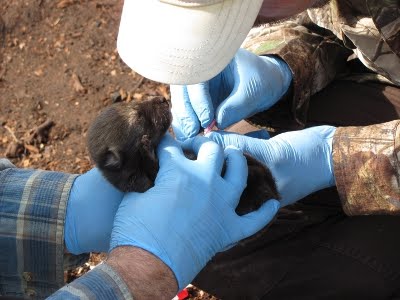
Management Techniques: Processing Pups
We also insert a PIT (Passive Integrated Transponder) tag, or microchip in each pup for identification later in life. The PIT tag is inserted just under the skin between the shoulder blades. This is the same type of transponder chip commonly used in the family dog and cat for identification. When the wolf pup has grown and we capture it to fit it with a radio-collar, a simple scan of the PIT tag will let us know exactly who the animal is. This prevents us from having to temporarily hold the animal in captivity while we await the results of a blood test to determine its identity.
When all the pups have been processed and their information recorded, we carefully return them to the den where their mother will return to care for them soon after our departure. After this process is completed, additional notes may be recorded pertaining to den characteristics, surrounding habitat, or any other interesting or distinquishing features present.
Monday, June 20, 2011
There’s More Than One Way To Catch a Wolf!
Female wolf 1686F was wearing a radio-collar that was near the end of its battery life. We needed to change her collar to prevent losing radio contact with her. The conventional method for catching a wolf to change its collar is to set modified leg-hold traps. For a mother with young pups, however, that’s not an option because there is always some risk involved (albeit small given the design of the trap). Instead, we decided our best option would be to sneak up to her den without being detected and capture her in a net as she exited. As you can see from the photo every once in a while a plan comes together!
Once her collar was replaced, we processed her pups, placed the pups back in the den, followed by mom, and moved on to our next den search.
Tuesday, April 5, 2011
Settling In
I started on a Monday by moving into the caretaker's cabin at Sandy Ridge, the Red Wolf Recovery Program's captive-holding facility. It was better than anything that I had thought would be provided in the woods. I have lights and heat and I even on occasion have running water and electricity. After getting settled into my cabin I was given a tour of the wolf enclosures where I would be spending most of my days. And on my first night in the cabin, the wolves howled for me. It was a great first day!
Over the rest of that week I began feeding the wolves on my own. I was also having animals brought in that would be staying for a couple of days that I had to get settled in by myself. I wasn’t sure if life could get better at that point.
Later, once I was comfortable with my regular duties and daily tasks, I went with one of the Red Wolf Recovery Program biologist to check traps. Though we didn’t catch anything that day I learned a lot. I saw how to set traps and what to look for when choosing a location for traps. I learned what made one place better than another. -- Jessica
Friday, March 18, 2011
Pack Intact
During whelping season, biologists conduct radio telemetry flights three times a week in an effort to pinpoint when and where each breeding female is denning. When a female restricts her movements to a particular place it is assumed that she is denning. Biologists then use ground radio telemetry to track to her and the den. Just as it appeared that 1470F was beginning to restrict her movements and establish a den, her radio telemetry signal was lost. Had something bad happened to her? Or was it simply a malfunctioning radio telemetry collar. We had hoped for the latter.
The only way to know for sure what had happened to 1047F was to set traps in an effort to capture her. Trapping would have to wait, though. If she was still around, and if she had a litter of pups, it would be too risky to capture her while she was raising a litter. Attempts to capture her would have to wait until the pups, if there were any, were large enough to be trapped and fitted with a radio telemetry collar.
Then, in June, a graduate student conducting research on red wolves was working in the Northern Pack’s territory when he happened to see three wolf puppies. As luck would have it, we were able to capture one of the puppies. A blood sample was taken, and genetics results confirmed the pup to be the offspring of 1470F and 1628M. This was great news! We now knew that 1470F had indeed given birth to her first litter. But we still weren’t sure of her presence. The pup, of course, was released right away to rejoin his pack.
In January (2011), we decided the pups would finally be big enough to be safely captured and fitted with a radio telemetry collar. Traps were set, and three pups were quickly captured, including the pup we had captured the previous June; they were in perfect health. Soon after, 1628M, the breeding male, was captured along with a fourth pup. But there was still no sign of mom. Finally, about a week later, our lucky day arrived. A strong, healthy 1470F was caught in our trap. The radio telemetry collar she was wearing had malfunctioned. We replaced it with a new one, and released the entire family back into their territory. -- Ryan
Friday, January 14, 2011
Management Techniques: Processing a Red Wolf
Wild red wolves are instinctively fearful of humans and are generally docile when handled. A wolf is typically restrained by placing a muzzle over its mouth, tying its hind legs together, and keeping a hand on its shoulder to hold it down. Occasionally a wolf may resist being muzzled to the extent that it must be sedated for the processing. Either way, all precautions are taken to maximize the safety of the wolf as well as the biologists handling the wolf.
Processing involves recording the wolf’s weight and body measurements, drawing a blood sample for future research, administering vaccines to prevent rabies and other common canid diseases, assessing the overall health of the wolf, and finally, fitting it with either a GPS or VHF radio telemetry collar so that it can be monitored upon release. After the processing is complete, the wolf is transported back to its home range and released.
Tuesday, November 23, 2010
A Notable Capture
Until his capture in late October we were uncertain if he had survived that first year as a pup. Having dispersed from his natal home range sometime last year, he was caught using a soft-catch trap in a territory belonging to a 2-year-old female wolf.
Radio-collared and released, our hopes are that he will remain in this area and pair-bond with the female wolf, forming a new breeding pair and possibly producing pups in 2011. -- Art
Thursday, September 23, 2010
A New Season

...and prepare for the long days of trapping by getting our trap gear in good working order.

We set hundreds of traps during the fall, and each trap has to be individually prepared for use. This means cleaning, boiling, and waxing the traps, replacing the rubber-padded jaws, and tuning them to catch red wolves.

Preparing traps is a laborious process, but everyone does their part to get the job done. And in the end a well prepared trap makes the field biologists' job of catching wolves a little easier.

Friday, June 25, 2010
Management Techniques: Trapping and Traps
We use a steel leg-hold trap, which requires an animal to step in the center of the trap triggering it to close on the animal’s foot. The traps we use are referred to as a "soft-catch" trap because of the rubber-padded "jaws." Obviously, it would not benefit us to injure the very animal we are trying to conserve, so our traps are highly modified to reduce injury.

The rubber-padded jaws, shock absorbers, and swivels in the trap design lessen the impact of the trap on the animal’s foot. In addition, we set our traps with a drag instead of staking the traps to the ground, which also greatly reduces potential injury to the wolves. Other variables that we consider in the safety and appropriateness of using leg-hold traps when trapping include the age of the target animal, weather conditions, how far the animal can travel after being trapped, other non-target animals in the area, and the level and experience of the field biologist. Field biologists with the Red Wolf Recovery Program have, on average, 16 years of experience trapping red wolves. -- Art