Showing posts with label conservation. Show all posts

Tuesday, April 22, 2014

Happy Earth Day!


Wild red wolf pup. Photo credit: B. Harrison/USFWS.

Today in honor of Earth Day 2014, we recognize the evolving challenges of conservation. Many threatened and endangered species are still in decline, causing scientists and concerned citizens to find new ways to find a more sustainable future.  How can you help?

1         1.  Learn about red wolves and other wildlife
Wolves and other predators are often misunderstood.  Education is key.  The more you know the more effective you will be at changing attitudes.  Visit the Red Wolf Recovery Program  and USFWS Endangered Species websites to get started! 

       2.   Visit a place where red wolves live
Plan a trip to red wolf country in northeastern North Carolina, the only place red wolves currently exist in the wild. Visit a zoo or nature center in the Red Wolf Species Survival Plan.  Find a red wolf exhibit near you.

       3.  Get involved
Support the work of the U.S. Fish and Wildlife Service, the Red Wolf Species Survival Plan, or one of our many partners.  We can work together!

      4.  Express your concerns about wildlife
Talk to elected officials, lawmakers, and leaders of civic and business organizations.  Ask them to support wildlife conservation efforts and programs. Find your state representative here.

      5.  Protect natural areas
Red wolves and other wildlife need space and wild lands to thrive.  Support land conservation initiatives and programs.  We work with The Nature Conservancy, the Wildlands Network, and other groups on land protection issues.

      6.  Reduce your carbon footprint
Climate change impacts many wildlife species.  Learn how you can calculate and reduce your carbon footprint.

Thursday, May 2, 2013

Please welcome Lizzy, the new Red Wolf Recovery Program intern!


Please help us welcome our most recent addition to the Red Wolf Recovery Program, Lizzy!  She is the red wolf caretaker intern from April through August 2013. 


Lizzy grew up in Herndon, Virginia and attended the University of Delaware, where she double majored in Wildlife Conservation and Agriculture & Natural Resources. Since she was a kid, animals and nature have always been her two biggest passions, due in part of the fact she was in Girl Scouts for 13 years. Lizzy has always known that working with wolves would be her end goal, and she is very happy that she’s received the opportunity to make this dream into reality.

We are very lucky to have her part of the program, as she brings lots of experience from a variety of different wildlife jobs, beginning with teaching hunter education for Vermont Fish & Wildlife, teaching animal education at the Cheyenne Mountain Zoo in Colorado, and husbandry for a wide variety of animals at Plumpton Park Zoo in Maryland. Lizzy began working with wolves at the Wolf Education and Research Center in Idaho, where she cared for wolves and participated in visitor education programs. Now, Lizzy is continuing this path with the Red Wolf Recovery Program.

Photo credit: USFWS/R. Nordsven

Long term, Lizzy’s goal is to continue working with wolves and become a wolf biologist. Living out a childhood dream has already been an incredible experience for her, and she’s sure it can only get better from here. She is still figuring out the next role after this position, but we’re excited to have her here now, and you can guarantee her future will have something to do with animals and improving their world.

Welcome Lizzy!

Tuesday, April 2, 2013

Meeting red wolf recovery criteria: Cryogenic preservation of red wolf sperm

Did you know that the current red wolf recovery plan has four recovery objectives? We often focus on establishing populations and avoiding extinction, but another recovery objective is to maintain the red wolf into perpetuity through embryo banking and cryogenic preservation of sperm. This work is coordinated through by the Red Wolf Species Survival Plan (SSP) through the Association of Zoos and Aquariums. The majority of this research occurs at Point Defiance Zoo and Aquarium under the guidance of the Red Wolf SSP Reproductive Advisor and SSP Coordinator.

Red wolf sperm under the microscope. Photo credit: Toronto Zoo.

Using technologies to support red wolf conservation and population sustainability relies on the help and expertise of many individuals and organizations. One such technology that the Red Wolf SSP began using in 1990 is the freezing of sperm collected from red wolves managed in the captive population. Initially developed within the livestock industry, the process involved in semen collection and freezing has been refined and improved over the years and is now used for a variety of species including those that may be threatened or endangered. In fact, many dog owners will “bank” samples to preserve, for example, sperm from valuable show or hunting dogs. These samples can potentially be used for artificial insemination to produce offspring once an animal is beyond its breeding age or has passed away. The International Canine Semen Bank (ICSB), located in Oregon, stores samples for the Red Wolf SSP and has produced dog litters from frozen semen that had been stored for 38 years prior to thawing and insemination.

Collected samples are analyzed under the microscope to exam sperm motility, concentration, and the percentage of normal shaped sperm. If these samples are sufficiently vigorous, the process for freezing begins. This basically involves combining the samples with an extender or cyroprotectant to safeguard the cells against damage during freezing followed by a slow cooling phase for 30 minutes. The samples are then carefully pipetted on to a block of dry ice with small indentations to form pellets and left to sit for 3 minutes. Finally, the pellets are plunged into liquid nitrogen, placed in small vials, and sent to ICSB for storage in liquid nitrogen tanks. 

Samples being "pelleted" onto dry ice.
Photo credit: Jesse Michener/Point Defiance Zoo & Aquarium. 

Karen Goodrowe-Beck, Red Wolf SSP Reproductive Advisor, 
processing samples for examination.
Photo credit: Jesse Michener/Point Defiance Zoo & Aquarium.
 
While this is kind of approach is not meant to replace red wolves breeding naturally, it is a valuable tool that we can use to manage the red wolf population into the future.

Thursday, February 28, 2013

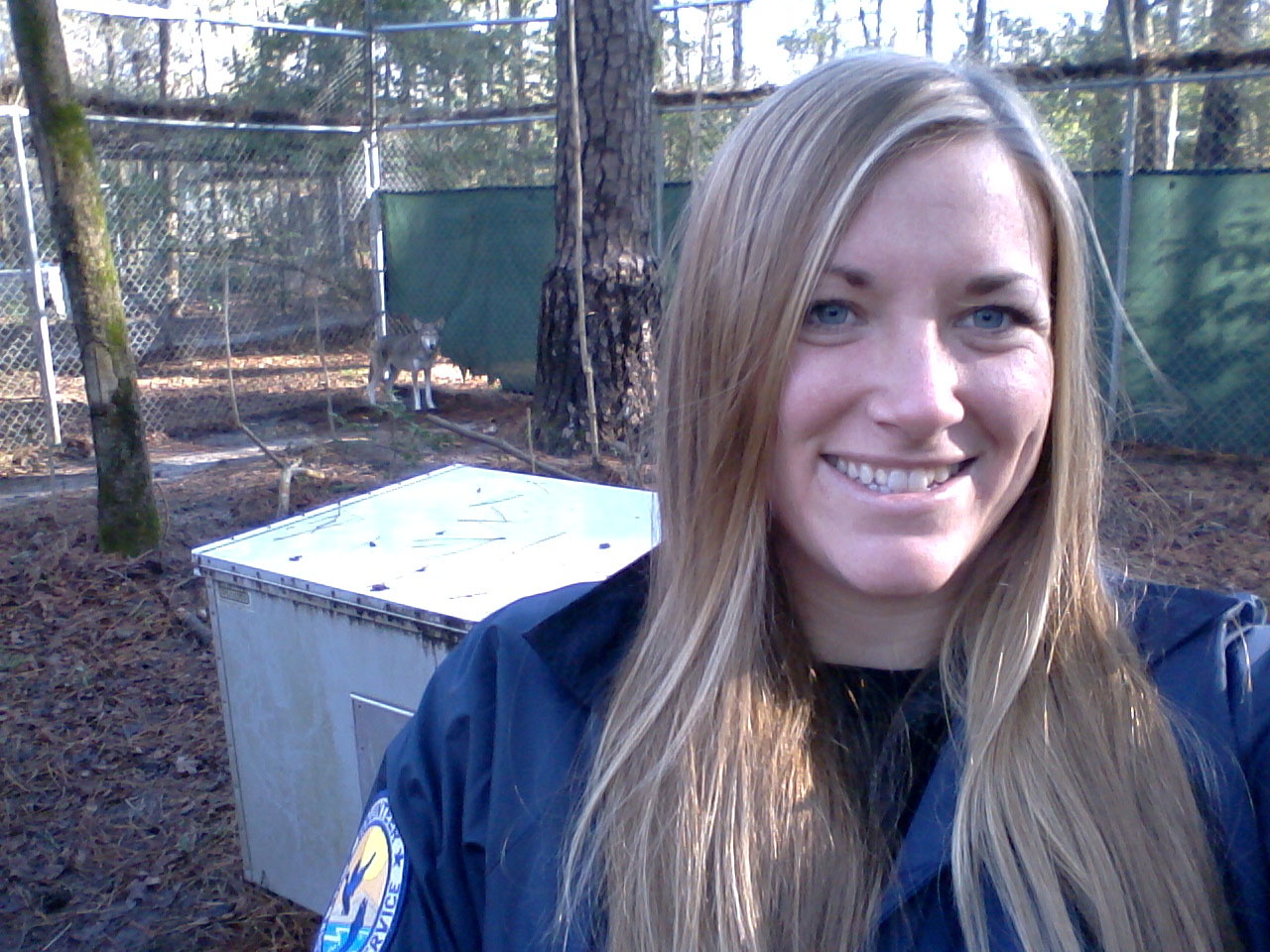
Meet Chelsea, our red wolf caretaker intern!


 Chelsea with a captive red wolf behind her.
 
Please help us welcome our most recent addition to the Red Wolf Recovery Program, Chelsea!  She is the red wolf caretaker intern from January to April 2013. Chelsea was born in Connecticut, grew up in Florida, and attended Unity College in Maine, receiving her Bachelors of Science in Wildlife Conservation in December 2011. 

Chelsea comes to us with a lot of wildlife conservation experience already under her belt.  Some of her previous work includes volunteering at Busch Wildlife Sanctuary, a wildlife rehab center, and researching piping plover and oystercatchers as an endangered shorebird intern at Chincoteague National Wildlife Refuge on Assateague Island. Last summer, she was a seabird researcher for Maine Coastal Islands National Wildlife Refuge and lived on the remote islands of Metinic and Petit Manan Island surveying and studying many different types of shorebirds including common, arctic terns, and Roseate terns, Atlantic puffins, razorbills, common murrs, common eiders, black guillemots, Leach’s storm-petrels, great black-backed gulls, laughing gulls, and herring gulls. From there, she continued on to the Loki Clan Wolf Refuge in the White mountains of New Hampshire, where she cared for 66 wolf hybrids, and participated in education and outreach.

We are very lucky to have her part of the program as Chelsea’s interests in wildlife conservation and wolves began long ago—she even wrote her first book about wolves when she was four (!) and has been following wolf recovery efforts for years. Her long-term goal is to find a permanent position with the U.S. Fish & Wildlife Service, a non-profit, nature center, wildlife rescue, or other facility that will allow her to continue to educate others and conserve wildlife. Together with her family, Chelsea has also created a non-profit organization, Balloons Blow, whose central goal is to bring awareness and educate others about the effects balloon releases and pollution has on the environment and wildlife. On her days off, you can find Chelsea cleaning nearby the beaches and removing washed up debris.

  Chelsea and a captive pair of red wolves.

Welcome, Chelsea!