Showing posts with label litter size. Show all posts

Wednesday, August 29, 2012

A Fostering First!

This year marks a first in red wolf pup fostering in the Red Wolf Recovery Program. But first, what is fostering?

Fostering is when pups from one litter (typically a captive-born litter) are placed in another litter (typically a wild-born litter) to be raised by parents that are not their own. Fostering pups from a captive litter to a wild litter has been a successful tool used by the Red Wolf Recovery Program as a means to increase the numbers of wild red wolves and enhance the genetic diversity of the wild population.

[Captive-born red wolf pups soon to be fostered into a wild litter. Photo credit: D. Beeland/USFWS]

The Red Wolf Recovery Program first fostered pups into a wild litter in 2002. A pair of two-week old pups born at the North Carolina Zoological Park were placed in a wild wolf den to be raised alongside the wild pups. The fostering was a success, and subsequent fostering efforts have yielded equal success. In fact, no wild red wolf mother has ever been known to reject a fostered pup, and the fostered pups’ survival rates appear to be equal to that of their wild-born “siblings.”

A few stipulations are adhered to when fostering pups, though. First, the pups are ideally no more than two-weeks of age at the time of the fostering. The mother’s maternal instinct is believed to be very strong with pups of this age, which decreases the likelihood of pup rejection. Also, the pups have limited mobility at this age, increasing the likelihood that they will stay in the den and not wander off before the mother returns. Another stipulation is that the captive-born pups should be very close in age to the wild-born pups. This decreases the likelihood of some of the pups out-competing others for food. Lastly, a potential foster mother is usually selected based on her having a relatively low number of pups in her litter, coupled with her proven ability to have successfully raised a litter in previous years. When combined, these conditions increase the likelihood that the mother wolf will be able to successfully raise a couple of extra pups added to her litter.

[Fostered red wolf pups in a den with their new "siblings." Photo credit: D. Beeland/USFWS]

So, what was so special about fostering pups in 2012? Well, this year we fostered two captive-born pups into a litter of three wild-born pups that were born to a mother that was once a captive-born fostered pup! In addition, two other wild red wolves (1 male and 1 female) that were once fostered pups had litters of their own this year!

These are a few of the great examples of how successful fostering pups has been through the years for the Red Wolf Recovery Program. -- Ryan

Friday, July 6, 2012

2012 Pup Season... What a success!

Another breeding season has come and gone in red wolf country. The final tally for wild-born red wolf pups was 40 in nine litters. An additional 41 pups from nine litters were born in Red Wolf Species Survival Plan (RWSSP) facilities across the country. All in all it was a pretty good year of pup production for the Red Wolf Recovery Program!

Thursday, June 7, 2012

Management Techniques: Processing Pups

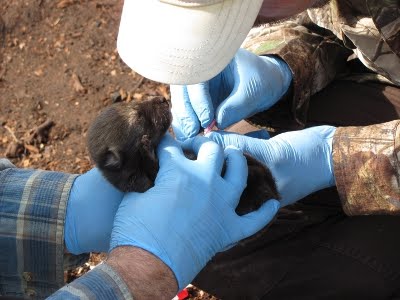
When a litter of red wolf pups is discovered by the Red Wolf Recovery Program, our primary concern is for the pups' safety. The pups are handled quickly and carefully, with as little disturbance to the den site as possible. We record the number of pups in the litter and the sex of each pup. A small sample of blood is drawn from each pup to determine or verify its pedigree, that is, who its parents are.

[Drawing blood from a red wolf pup. Photo Credit: W. Waddell/USFWS]

We also insert a PIT (Passive Integrated Transponder) tag, or microchip in each pup for identification later in life. The PIT tag is inserted just under the skin between the shoulder blades. This is the same type of transponder chip commonly used in the family dog and cat for identification. When the wolf pup has grown and we capture it to fit it with a radio-collar, a simple scan of the PIT tag will let us know exactly who the animal is. This prevents us from having to temporarily hold the animal in captivity while we await the results of a blood test to determine its identity.

[Inserting a PIT tag into a red wolf pup. Photo Credit: W. Waddell/USFWS]

When all the pups have been processed and their information recorded, we carefully return them to the den where their mother will return to care for them soon after our departure. After this process is completed, additional notes may be recorded pertaining to den characteristics, surrounding habitat, or any other interesting or distinquishing features present.

[Scanning a PIT tag to ensure it works. Photo Credit: D. Rabon/USFWS]

Sunday, May 13, 2012

Tuesday, June 14, 2011

2011: A Good Year for Red Wolf Recruitment

As the 2011 denning season winds down for the Red Wolf Recovery Program, the tally of red wolf pups born in the wild appears to be 46. This was an unexpectedly strong year for recruitment in the wild population. The number of mortalities of breeding wolves in recent years presented a challenge in optimism going into this year's denning season. Fortunately, 11 pairs of breeding wolves, including seven newly formed pairs and first time breeders, gave us a lot to be optimistic about.

[Red wolf pups. Photo credit: R. Nordsven/USFWS]

Thursday, May 5, 2011

A Wolf Named "Willy"

During the third week of April, in the midst of our annual search for red wolf dens, biologists with the Red Wolf Recovery Program were accompanied by a special guest, Red Wolf SSP (Species Survival Plan) Coordinator, Will Waddell. Will, based at Point Defiance Zoo and Aquarium in Tacoma, Washington, has been leading the red wolf captive-breeding effort for nearly 20 years. In doing so, he has been involved in the birth and care of countless litters of captive red wolf pups. But, surprisingly, he has never been involved in the finding and processing of a litter of wild red wolf pups. This particular denning season he was able to lend the field biologists a helping hand, and we were more than happy to have him on board.

After a lengthy, hot, and unsuccessful search amidst a large block of pine trees and tangles of briars on the first day of Will's visit, Day 2 proved to be much more rewarding. The den was located under a grove of myrtle bushes in the middle of, what else, a large patch of briars, to a first time mother. Although we were hoping for a litter from her this year, we weren’t really counting on one because of her young age. So, finding that she had had a litter, even though it was only one pup, was a pleasant surprise. After realizing the healthy week-old pup was a male, Will declared “We’ll have to call him Willy!”

Technically, red wolves are not given names, and this pup will be no different. Rather, he will be assigned a studbook number (by his namesake, ironically) to which he will be officially referred. But unofficially, he may very well be known for some time by the Red Wolf Recovery Program biologists as the wolf named “Willy”. -- Ryan

[Will and Willy. Photo credit: A. Beyer/USFWS]

Thursday, April 28, 2011

Denning Season Is Here Again

It’s that time of year again. The days are growing longer and notably warmer, and field biologists with the Red Wolf Recovery Program find themselves spending the majority of their days climbing, crawling, and wriggling under the hot sun through some of the most inhospitable habitat imaginable. Ticks, chiggers, horseflies, poison ivy, and entanglements of briars are just a few of the obstacles in their path as they embark on this year’s search for a fuzzy new generation of red wolves. Despite the unpleasantries, denning season is without a doubt the highlight of the year for biologists. It is this new recruitment of red wolf puppies each spring that essentially represents the fruits of the previous year’s labor. Each year, the number of new wolf litters allows biologists to gauge how successful the previous year’s efforts were in trapping and tracking wolves, dealing with mortalities, forming new pairs, and preventing hybridization.

[Red wolf pups approx. 7 days old. Photo: R. Nordsven/USFWS]


This year’s den search got off to a nice start. The first two litters found were of partially unknown parentage. Of course, the maternal sides of the pups’ pedigrees were known. It was the paternal side that was in question. Fortunately, blood results indicated that the puppies from both litters were indeed pure red wolves and not wolf/coyote hybrids. This was great news, and it gave us a new sense of optimism right out of the gate regarding this year’s denning season. Adding to our optimism was the fact that both of the females were first time mothers, having taken over as the new breeding females after the deaths of their own mothers. We weren’t sure if we would get litters out of these females this year, so again, it was a great start.

[Taking a blood sample from a Milltail Pack pup. Photo: D.J. Sharp]


The next litter discovered was from the Milltail Pack on Alligator River National Wildlife Refuge. There were no pedigree questions here as we knew who both parents were. And it was even more good news when we found seven healthy puppies. An average red wolf litter is four pups, so a litter of seven is always a welcome sight.

[Red wolf pups approx. 12 days old. Photo: R. Nordsven/USFWS]


Additional litters were found during the next several days; the current count stands at nine litters and 37 pups, with a few more possible litters yet to be found. Following a tough year of losing a number of breeding wolves due to premature mortality, this is shaping up to be a surprisingly good year of pup production. -- Ryan

Friday, April 30, 2010

Spring brings red wolf pups!


Spring is a special time of year for the field biologists with the Red Wolf Recovery Program. The days are getting longer, the temperatures are warming, and red wolves will soon be giving birth to pups!

These two female pups, born to the Kilkenny pack on or about April 18, 2010, were estimated to be about 7 to 8 days old when found. Red wolves rear their young in dens of shallow depressions with dense vegetation for cover or in deep burrows along the slopes of brushy windrows or canal banks. They also may create a den at the base of a large tree, which is where these two pups were found. Pregnant females may dig several dens during the breeding season. Den areas are used from April through July, corresponding to the whelping and pup-rearing periods. Litter sizes can range from 1 to 11 pups, with an average of four pups per litter.