
Friday, July 6, 2012
2012 Pup Season... What a success!
Another breeding season has come and gone in red wolf country. The final tally for wild-born red wolf pups was 40 in nine litters. An additional 41 pups from nine litters were born in Red Wolf Species Survival Plan (RWSSP) facilities across the country. All in all it was a pretty good year of pup production for the Red Wolf Recovery Program!


Wednesday, June 27, 2012
Our new den...

The long-awaited opening of the Coastal North Carolina National Wildlife Refuges Gateway Visitor Center will be this Friday, June 29, 2012. The Visitor Center is located on US64 on the north end of Roanoke Island (north of Manteo) across from the Fort Raleigh Historic Site, The Lost Colony, and the Elizabethan Gardens. The Visitor Center will be open to the public from 9 am until 4 pm daily.

The Visitor Center's gallery features a wide variety of educational and entertaining exhibits designed, fabricated, and recently installed by Wilderness Graphics, Inc. Exhibits include a Cessna airplane where visitors may "fly-over" the 11 refuges represented at the Center, a multi-sensory theater, and realistic dioramas, including a very unique red wolf exhibit. The Coastal Wildlife Refuge Society hosts "Wild Things", a Book/Gift Shop where visitors may purchase refuge items and a wide assortment of books and other educational merchandise. Entry is FREE. A Grand Opening Celebration will be planned for the fall.
Thursday, June 7, 2012
Management Techniques: Processing Pups
When a litter of red wolf pups is discovered by the Red Wolf Recovery Program, our primary concern is for the pups' safety. The pups are handled quickly and carefully, with as little disturbance to the den site as possible. We record the number of pups in the litter and the sex of each pup. A small sample of blood is drawn from each pup to determine or verify its pedigree, that is, who its parents are.

[Drawing blood from a red wolf pup. Photo Credit: W. Waddell/USFWS]
We also insert a PIT (Passive Integrated Transponder) tag, or microchip in each pup for identification later in life. The PIT tag is inserted just under the skin between the shoulder blades. This is the same type of transponder chip commonly used in the family dog and cat for identification. When the wolf pup has grown and we capture it to fit it with a radio-collar, a simple scan of the PIT tag will let us know exactly who the animal is. This prevents us from having to temporarily hold the animal in captivity while we await the results of a blood test to determine its identity.

[Inserting a PIT tag into a red wolf pup. Photo Credit: W. Waddell/USFWS]
When all the pups have been processed and their information recorded, we carefully return them to the den where their mother will return to care for them soon after our departure. After this process is completed, additional notes may be recorded pertaining to den characteristics, surrounding habitat, or any other interesting or distinquishing features present.

[Scanning a PIT tag to ensure it works. Photo Credit: D. Rabon/USFWS]
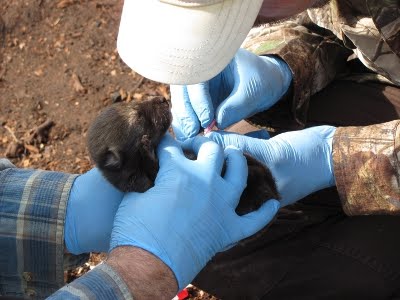
We also insert a PIT (Passive Integrated Transponder) tag, or microchip in each pup for identification later in life. The PIT tag is inserted just under the skin between the shoulder blades. This is the same type of transponder chip commonly used in the family dog and cat for identification. When the wolf pup has grown and we capture it to fit it with a radio-collar, a simple scan of the PIT tag will let us know exactly who the animal is. This prevents us from having to temporarily hold the animal in captivity while we await the results of a blood test to determine its identity.

When all the pups have been processed and their information recorded, we carefully return them to the den where their mother will return to care for them soon after our departure. After this process is completed, additional notes may be recorded pertaining to den characteristics, surrounding habitat, or any other interesting or distinquishing features present.

Wednesday, May 23, 2012
Memorial Day 2012

To honor the men and women that have served our country, Alligator River National Wildlife Refuge and the Red Wolf Recovery Program are hosting a very special Memorial Day howling on Saturday, May 26, 2012. The free event starts at 7:00 pm at the Creef Cut Wildlife Trail parking lot. No registration is required, but space is limited. Visit us on Facebook for more information.
Wednesday, May 16, 2012
Celebrate America's Wildlife Legacy

On 18 May 2012 the Red Wolf Recovery Program and the U.S. Fish and Wildlife Service will observe and celebrate Endangered Species Day in order to recognize the national effort to protect and recover our nation's endangered species.
Endangered Species Day is an opportunity for people young and old to learn about the importance of protecting endangered species and everyday actions that people can take to help protect our nation’s disappearing wildlife and last remaining open space. Protecting America’s wildlife and plants today is a legacy we leave to our children and grandchildren, so that all Americans can experience the rich variety of native species that help to define our nation.
Started by the United States Senate, Endangered Species Day is the third Friday in May. Every year, thousands of people throughout the country celebrate Endangered Species Day at parks, wildlife refuges, zoos, aquariums, botanical gardens, libraries, schools and community centers. You can participate in festivals, field trips, park tours, community clean-ups, film showings, classroom presentations, and many other fun and educational activities.
In partnership with the Endangered Species Coalition and the Association of Zoos and Aquariums, events will be scheduled throughout the country. Go to www.endangeredspeciesday.org for more information on Endangered Species Day events near you!

Sunday, May 13, 2012

Friday, May 4, 2012
2012: A Den Odyssey
I watch as Chris crawls under a fallen pine that has been down long enough for the bark to begin to fall freely from its dry yellow trunk. He is out of sight now, and still. The wolf’s signal fluctuated and got weaker just before Chris crawled under the log, but I did not hear her move off. I begin to move forward when he calls quietly, “I found it.” I move on up not worried about the noise at this point. As I crawl under the dead pine log I see the bare dirt of a day bed where she lay just prior to moving off. She was less than 15 feet from Chris when she spooked. The day bed has tufts of belly fur in and around it. The wolves begin to shed their belly fur just prior to giving birth to ease the pup’s access to the teats. Chris is another 15 feet beyond the daybed sitting at the entrance to a dug den. Black brown peat soil forms a slight mound at the entrance, naturally forming a high spot that prevents water draining into the den. I wonder if the mound and its function are intentional, a product of natural selection.

[The den. Photo credit: C. Lucash/USFWS]
I move forward and get the gear ready. Chris sees two pups and then scoots down the entrance head first. It turns out to be five pups, three males and two females. We carefully get a few drops of blood and implant a transponder in each pup. Chris and I have done this routine so often we don’t even need to speak to know what the other needs. He holds the pup while I draw blood and implant the transponder. He opens the cryovial while I pipette the blood from the needle. I drop in the pipette and transfer the blood while he holds pressure on the pup’s leg to stop the bleeding. I hold the cryovial while he screws on the cap. Everything goes smoothly; the pups are quiet for the most part. Mom must have fed them shortly before we arrived. They appear to be 5-7 days old, nice and plump. We place them in the fanny pouch to make it easy for Chris to transfer them back into the den. In go the pups, and Chris right behind them. Chris hands the bag back out and I grab his ankle to help him out. We gather gear and get location information. Getting out is quicker, but not always easier, than getting in. We quickly and somewhat quietly head back to the trucks. Mom will return shortly to check on the pups. She was waiting the whole time just a short distance away.

[The pups. Photo credit: F. Mauney/USFWS]
Back at the trucks Chris and I pick ticks and strip off our protective gear. Chris gets the blood, transponder information, and den coordinates together for Art. We load up in our trucks and head our separate ways. The first den of the year is done, but the year’s den work has just begun. -- Ford

I move forward and get the gear ready. Chris sees two pups and then scoots down the entrance head first. It turns out to be five pups, three males and two females. We carefully get a few drops of blood and implant a transponder in each pup. Chris and I have done this routine so often we don’t even need to speak to know what the other needs. He holds the pup while I draw blood and implant the transponder. He opens the cryovial while I pipette the blood from the needle. I drop in the pipette and transfer the blood while he holds pressure on the pup’s leg to stop the bleeding. I hold the cryovial while he screws on the cap. Everything goes smoothly; the pups are quiet for the most part. Mom must have fed them shortly before we arrived. They appear to be 5-7 days old, nice and plump. We place them in the fanny pouch to make it easy for Chris to transfer them back into the den. In go the pups, and Chris right behind them. Chris hands the bag back out and I grab his ankle to help him out. We gather gear and get location information. Getting out is quicker, but not always easier, than getting in. We quickly and somewhat quietly head back to the trucks. Mom will return shortly to check on the pups. She was waiting the whole time just a short distance away.

Back at the trucks Chris and I pick ticks and strip off our protective gear. Chris gets the blood, transponder information, and den coordinates together for Art. We load up in our trucks and head our separate ways. The first den of the year is done, but the year’s den work has just begun. -- Ford
Subscribe to:
Posts (Atom)


